Steven and I arrived in Singapore early on the morning of the 19th. From my window in the plane as we neared the airport, I was surprised to note that Singapore looked quite similar to my childhood home in South Florida. Wide paved streets lined with palm trees led to small clusters of bright, shiny buildings reflecting the clear blue sky and incoming rays of the sun. Coming from the crowded, dirty, jam-packed streets of Saigon, I could almost imagine myself descending into Palm Beach International airport.
While I was looking forward to finding the first passably comfortable spot in the airport to sleep until our 8 o'clock flight to Bali, Steven was intent on using the long layover to get out and see the city and, if possible, to arrange a hotel stay for the evening of our late night/early morning arrival back in Singapore on the 31st of December.
I had heard that Singapore's airport was in a class unto itself, but I was still quite impressed with the wide open spaces, modern facade, free internet and multitude of things to do while away your time between flights. I was even more impressed by the fact that you could easily board Singapore's metro system from the airport and be in downtown Singapore in less than 20 minutes for under $5. I was liking Singapore already.
We made our way to the train station and figured out how to buy a one way ticket to our desired stop without too much trouble. After pushing our recently acquired Singaporean dollars into the machine, we were rewarded with a plastic card that was to be our ticket, until we returned it for a one dollar refund, at the end of our trip. Fancy stuff.
We spent the afternoon rushing quickly through Singapore's Little India, following our Lonely Planet map from hostel (Closed), to hostel (no rooms available), to hostel ($60 US a night), to hostel before finally settling on a room in the Hawaii Hostel near Bugis, a somewhat dilapidated looking place in one of the many hearts, of Singapore's many upscale shopping districts.
Finally set with a hotel, we wandered back to little India where we had lunch for under $3 US in one of Little India's many authentically Indian restaurants filled with Indian men sopping up food with rice and their bare hands
With full stomachs and a reservation for New Year's Eve, we hoped back on the metro and headed East to the airport.
Sunday, February 01, 2009


Friday, January 09, 2009
December 2008
Just before the Thanksgiving break, I found myself in the interesting predicament of going from not much at all to do with my time, to having not enough time to anything but work. I was interview, "reviewed," and hired as an English teacher with the United Nations Cultural, Educational and Scientific Organization (UNESCO), something I was immediately excited to have on my resume if nothing else, volunteering 12 - 14 hours at Saigon Children's Charity, tutoring three evenings a week, providing private ESL lessons for two hours once a week and taking Vietnamese lessons two evenings a week. To fill up my spare time, I picked up a contract research and writing assignment for a career mobility website writing, ironically given my experience in the past few months, about how to find work in Viet Nam. I was thrilled to have so much to do and to feel productive, not only by contributing to our family income, but by actually doing, at least a few things, that I love to do.
For the three weeks between Thanksgiving and Christmas, Steven was a man unto himself. While I sat, almost literally, glued to to our burgundy pleather couch for hours on end researching local companies, writing lesson plans and setting up interviews, Steven went shopping, cooked dinner, cleaned the house, planned his lessons and put up with my occasional outburst of "This is INSANE! How am I possibily going to get all this done in time to leave for Bali?!" and worked at his own full time teaching job. With a deadline of Friday, December 19th, I had an incredibly detailed research project to produce, over 250 three part-tests to grade, lessons to plan and a job to get up for at 6 in the morning four days a week.
Luckily things began to fall in place for me during the last week before vacation. I was informed that the students had a week off after exams, my tutoree canceled two evenings in a row to study for her own exams, my ESL student canceled one lesson on account of having so much of her own work to do and, apologizing profusely, I begged off of volunteer work for the week. With a week cleared of outside obligations, I sat and wrote. And sat and wrote. And sat and wrote. At 5 in the morning on Friday the 19th, just as Steven's alarm was going off to wake him up to set off for the airport, I was into my 24th consecutive hour of editing. I attached the now 68 page document to an email and hit send.
Feeling relieved to have completed my project before the deadline and grateful to have what had been a hellish month of little exercise, few showers and near complete dependence on my husband, behind me, I quickly straightened up the apartment, hauled on my pack and set off for a good solid two hours of sleep on the plane ride to Singapore.
Christmas in Viet Nam
While Viet Nam may be politically non-religious, many Vietnamese in Saigon celebrate Christmas, if not in the religious sense, at least in the commercial sense. Unfortunately our camera isn't great with night shots, but I've uploaded a few pictures from our evening out to see the Christmas lights.


Thanksgiving in Da Lat
Steven and I see every long weekend as an excuse to travel and our four day Thanksgiving weekend was no different. We may not have Turkey, but we would have a memorable Thanksgiving.
We decided to spend the weekend in Da Lat, an old French getaway in the mountains in south Viet Nam. I had spend some time there in 2005 and remembered enjoying the cool weather, beautiful countryside and old colonial construction. Friends of ours from Steven's school had recommended a hotel where you could get a great room for $10 and had the option of taking some local tours with the owner's son, who spoke perfect English.
Not wanting to spend the seven hours we were told it takes to get from HCMC to Da Lat in a bus during the day, we opted for an overnight bus leaving at 11:15 p.m., scheduled to arrive in Da Lat at 6:15 a.m. the following morning. When it was time for us to board, Steven and I handed our bag over to the man putting luggage in the luggage compartment and settled into our seats in the very front of the bus to the right of the driver. While our seats gave us a great view, they also put us in the position of being the first through the windshield if the bus happened to careen over a cliff at 70 miles an hour on a windy mountain pass (a fact that occurred to me only after waking up briefly a few hours later to see the world passing by in a green and black blur).
We settled in for the ride and I drifted in and out of sleep, while Steven did whatever it is that he does when I am drifting in and out of sleep. While we slept, our driver, apparently an old hand at the Daytona 500 in a previous life, got us to Da Lat in record time, pulling into the bus station at 4:00 a.m., two hours ahead of schedule.
Not wanting to stay at the bus station and assuming, perhaps, that our hotel would have a bell that they wouldn't mind us ringing at 4 in the morning, Steven and I informed the bus company cab that we wanted to go to the Pink House.
The cab followed a small lane back to the main street, turned left and headed up a steep embankment, making a left into a smaller street at the top of the hill. After driving about 100 meters down the darkened street, our cab stopped in front of a big Pink house surrounded by a metal gate. Steve and I unloaded our bags and watched as the tail lights of the cab disappeared around the corner. Looking at each other, we wondered aloud what to do now. We were outside of a locked gate in the middle of the night, in weather much cooler than we were used to, with less than four hours of sleep apiece and only a vague idea of how to get back to the bus station. While Steven sat down to put on a pair of warm socks, I jumped around to keep myself warm and realized that even without much sleep, I was full of energy, like a kid on Chrismas, excited to be on vacation and back in Da Lat. We debated for a few moments on whether we should return to the bus station or stay at the hotel until it opened, not really coming to any conclusion, content, for the moment to enjoy the chill in the air and the peace of our surroundings.
A few moments later, just about 4:15 a.m. we heard a noise from inside the house and saw a figure approaching us. We waited while an older Vietnamese man walked up to the gate and, seeming somewhat startled to see us, opened the lock and ushered us in. We followed him into the house into a large, open room with a large reception area, a door opening up in to what appeared to be the family kitchen and a large polished wooden staircase leading up to the guest rooms, where we waited as he roused a figure under a blanket on the couch. The figure, a young man in his early twenties, rubbed his eyes and looked around groggily before settling his gaze on us. Still seemingly half asleep, he asked us if we wanted a room and then in response to our affirmative reply, walked behind the desk and obtained a key. We followed him up the stairs to the second floor and gladly accepted the key to the nicely furnished, double room for $10 a night. Without even taking the time to unpack, Steven and I crawled under the covers and went to sleep.
The following day, we arose in the late morning and made our way downstairs where we met Rot, the owner's son, who had so enchanted our friends a few weeks earlier. Both Steven and I liked him immediately. He spoke perfect English with the Vietnamese accent we have come to know so well and explained to us how his tours were not like those that were offered through the tour companies. He knew that most backpackers want to see the "real" Viet Nam and are often disappointed by large tours that take them to touristy sites where people act out the local customs and lead you out by way of the gift shop. He offered a one day tour to see some local sights, have lunch with is family in the countryside, meet an indigenous family that were neighbors of his and learn more about the local culture as well as mainstream Vietnamese culture. We told him that we were interested, but just needed some time to decide which day we wanted to go. He said that we could just let him know the evening before and sent us on our way with a recommendation for a cheap local restaurant and a hand drawn map of the city.
Leaving Rot and the Pink House behind, we followed his map to the restaurant he had recommended and were happy to find that it was packed with Vietnamese. We were led up through the crowded lower dining room, up the stairs and to a table in a second floor dining area, already at half capacity. We decided to order the only thing we know how to order in Vietnamese, "Pho Ga," or Vietnamese chicken soup.
After a delicious lunch, we spent the afternoon wandering around Da Lat through a haze of intermittent drizzle and a cloud of gray skies. We toured the botanical gardens, checked out the old train station where Steven marveled at the old coal burning trains, wandered through the fancy Sofitel Da Lat Place turned hotel and took in the expanse of the hilly mountain town from our vantage point at the top of Da Lat's famed "Crazy House," a hotel built by a female architect known for her imaginative designs.
Upon returning to the hotel that evening, we informed Rot that we would be interested in his tour the following morning and had also decided to join him in his cooking class that evening. Exhausted, but happy to have hit the majority of Da Lat's central sights, we turned in for the evening.
We awoke early the next morning and joined Rot and another guest, Tim, an artist from upstate New York, in front of the Inn where we were provided with our bike for the day. Rot's tour included our own transport and Steven happily mounted the bike while I looked forward to a day of amazing scenery.
Leaving Da Lat, we followed a curving mountain road through dense pine forest with a biting chill in the air. As we lost altitude, the forest began to thin and the countryside fanned out on either side of us, painting picturesque with square patches of farmland in various shades of green surrounding little wooden farmhouses. Figures in traditional Vietnamese conical hats bent low to the ground tending their crops while upright torsos stuffed with straw protected them from predators.
Our first stop was Thien An Cricket Farm, a nondescript house on a rocky country road. After I'd jumped off the back, Steven parked the bike, while I took a picture of a tarp filled with coffee beans drying in front of the house next door.
Rot let us through the side gate, alongside of the house to an open air structure in the back of the house. He knocked loudly on the back door as we passed and we were soon joined by a young Vietnamese man whom Rot introduced as the proprietor of the cricket farm.
The farm consisted of two separate tent-like structures, both with rows of boxes and large plastic bowls filled with crickets in various stages of development. To our right in the first tent was a row of multi-colored plastic bowls containing an overturned woven basket and a makeshift cricket water bottle fashioned out of old plastic soda bottles. The center isle was made up of two rows of open boxes covered in white plastic sheeting housing the same contents as the plastic bowls. Each successive bowl or box housed an inordinate amount of little crickets. I wondered aloud why they all didn't just jump out and run away. Our host answered my question by explaining that the crickets were more active at night, so their containers are covered, but during the day the are content to stay in their respective homes.
On a counter next to us, a plate lay covered by a the lid of a pot. On the plate lay what looked like deep fried balls of dough with suspiciously crickety looking legs poking through some of the batter. I was content just to marvel at them, but all of a sudden Steven, Rot and the cricket guy were egging me on to get me to try one. Not one to shy from a challenge, I popped one in my mouth and chewed, noting that probably just about anything deep fried in dough tastes like deep fried dough.
Our next stop was a silk factory, in which the process of creating silk fabrics ranged from the boiling of the silk worm, bought from local silkworm "growers," to processing the silk thread, to the final creation and sale of silk products. The factory was another open air structure, with no walls and only a partial tin roof to keep out the rain. Even from just outside, the noise from the machines was almost deafening. When we walked into the factory, our first image was of a stack of circular trays woven from palm fronds containing hundreds of silk worm cocoons.
Before we went further into the factory, Rot showed us a smaller tray in which a silk moth was laying eggs. We then followed Rot over towards the back of the room where a machine winding silk into large blue spools ran the length of the room. While we watched, he explained that the cocoons were placed into the water to loosen them up. The women working the machine, would run their fingers through the water to pick up the end of a loose thread and hold it up to be caught by the end of a spinning metal rod attached to one of the machine's many spools. The thread would then be pulled up the length of the rod and join the silk thread winding onto the spool. As the thread wound around the spool, the cocoon spun rapidly in the water as the hard work of each little worm was quickly undone. It was neat to look in the water and see all of the cocoons spinning in the water.
We then turned to another machine behind us, somewhat similar the the first except that for the drying process, the spools of wound silk thread laid in rows on the floor and the silk was unwound from those spools, only to be immediately wound onto much larger spools to allow it sufficient air to dry.
As we marveled at what seemed to us as such an archaic, yet fascinating process, we walked over to the other side of the room where an enormous loom wove the silk into reams of intricately patterned fabric. The patterns were determined by pattern boards that could be interchanged in the loom. Rot explained to us that one man's sole job was to keep the looms running. With what seemed like thousands of threads, thread into thousands of needles, raising and falling by the second, I could imagine what a mess it would be if the machine malfunctioned.
Walking back towards the front, Rot introduced us to the owner of the factory and explained that once the fabric was completed, he would personally dye each fabric, a process which, as a family secret, was not shared with others in the factory. Fighting back the temptation to buy an attractive silk dress, I followed Tim, Steven and Rot back out to the bikes.
Our next stop was one of Da Lat's largest waterfalls. We parked our bikes at the top and followed Rot down a path, across a narrow wooden bridge to a path, intermittently made of stairs carved out of stones, and the stones themselves, to a group of boulders that lead us closer to the waterfall. We jumped from boulder to boulder, navigating our way over rocky outcroppings, finally coming to a narrow opening in a rock. When we squeezed through the opening, we found that it led to large cavern behind the waterfall. The air was cool with mist and the roar of the water filled the space, leaving me to wish that Steven and I had found the spot on our own and that we could hide out for a couple of hours hidden from view, enjoying our own private world in this unique space. But it was not to be and we headed back out the way we came.
Our last stop was a mushroom farm, where Van took us into a large "mushroom hut" to show us how the mushrooms grow.
After the mushroom farm, we rode back up out of the valley back into Da Lat. As the farmland gave way to the pine trees, the air grew colder and the sky opened up and rained down icy pellets of rain that hit us like frozen needles. The faster Steven drove to escape the rain, the harder the raindrops seemed to fall. We were happy to get back to the hotel with plenty of time to dry off and take a nap before dinner.
When it was time for us to go to dinner, we met up with Rot and another couple from Switzerland in the lobby. We followed Rot down the road to his sister's house where we spent the evening learning how to make Vietnamese Spring Rolls and Vietnamese Curry, over a bottle of Vietnamese wine. The food was delicious and the conversation was fascinating, alternating from the logistics of living in a country with three official languages to what it was like growing up after one war, in the midst of another war with a neighboring country. It was a great way to end the day.
DA LAT DAY ONE - SIGHTSEEING AROUND TOWN

Da Lat's Urban Farms


Da Lat's Botanical Gardens

Outside of Da Lat Train Station


My first real "billiard room!"

Stairs in Da Lat's Crazy House

A walkway up the the rooms

A room in the Crazy House

The Tiger Room in the Crazy House

View from a window in the yet unfinished portion of the Crazy House
DA LAT DAY TWO - OUR COUNTRYSIDE TOUR

Coffee beans drying in the yard

Thien An Cricket Farm

Inside the Cricket Farm

Cricket Nuggets. Yum!

Silk Worm Cocoons

More Silk Worm Cocoons

Lots More Silk Worm Cocoons

Silk Retrieval Machine

Silk Thread Drying Machine

Inside the Silk Factory

Weaving Pattern Boards to "Program" Loom


Loom Weaving Patterned Silk

Steven and I at the top of a Waterfall

Hiking Down to the Bottom of the Waterfall


Behind the Waterfall

Mushroom Hut

Drying Mushrooms

Growing Mushrooms inside the Hut


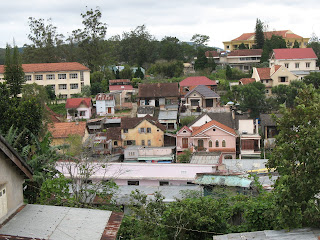
Da Lat City

Goldfish for Sale


View from our room


Path around the Lake
We decided to spend the weekend in Da Lat, an old French getaway in the mountains in south Viet Nam. I had spend some time there in 2005 and remembered enjoying the cool weather, beautiful countryside and old colonial construction. Friends of ours from Steven's school had recommended a hotel where you could get a great room for $10 and had the option of taking some local tours with the owner's son, who spoke perfect English.
Not wanting to spend the seven hours we were told it takes to get from HCMC to Da Lat in a bus during the day, we opted for an overnight bus leaving at 11:15 p.m., scheduled to arrive in Da Lat at 6:15 a.m. the following morning. When it was time for us to board, Steven and I handed our bag over to the man putting luggage in the luggage compartment and settled into our seats in the very front of the bus to the right of the driver. While our seats gave us a great view, they also put us in the position of being the first through the windshield if the bus happened to careen over a cliff at 70 miles an hour on a windy mountain pass (a fact that occurred to me only after waking up briefly a few hours later to see the world passing by in a green and black blur).
We settled in for the ride and I drifted in and out of sleep, while Steven did whatever it is that he does when I am drifting in and out of sleep. While we slept, our driver, apparently an old hand at the Daytona 500 in a previous life, got us to Da Lat in record time, pulling into the bus station at 4:00 a.m., two hours ahead of schedule.
Not wanting to stay at the bus station and assuming, perhaps, that our hotel would have a bell that they wouldn't mind us ringing at 4 in the morning, Steven and I informed the bus company cab that we wanted to go to the Pink House.
The cab followed a small lane back to the main street, turned left and headed up a steep embankment, making a left into a smaller street at the top of the hill. After driving about 100 meters down the darkened street, our cab stopped in front of a big Pink house surrounded by a metal gate. Steve and I unloaded our bags and watched as the tail lights of the cab disappeared around the corner. Looking at each other, we wondered aloud what to do now. We were outside of a locked gate in the middle of the night, in weather much cooler than we were used to, with less than four hours of sleep apiece and only a vague idea of how to get back to the bus station. While Steven sat down to put on a pair of warm socks, I jumped around to keep myself warm and realized that even without much sleep, I was full of energy, like a kid on Chrismas, excited to be on vacation and back in Da Lat. We debated for a few moments on whether we should return to the bus station or stay at the hotel until it opened, not really coming to any conclusion, content, for the moment to enjoy the chill in the air and the peace of our surroundings.
A few moments later, just about 4:15 a.m. we heard a noise from inside the house and saw a figure approaching us. We waited while an older Vietnamese man walked up to the gate and, seeming somewhat startled to see us, opened the lock and ushered us in. We followed him into the house into a large, open room with a large reception area, a door opening up in to what appeared to be the family kitchen and a large polished wooden staircase leading up to the guest rooms, where we waited as he roused a figure under a blanket on the couch. The figure, a young man in his early twenties, rubbed his eyes and looked around groggily before settling his gaze on us. Still seemingly half asleep, he asked us if we wanted a room and then in response to our affirmative reply, walked behind the desk and obtained a key. We followed him up the stairs to the second floor and gladly accepted the key to the nicely furnished, double room for $10 a night. Without even taking the time to unpack, Steven and I crawled under the covers and went to sleep.
The following day, we arose in the late morning and made our way downstairs where we met Rot, the owner's son, who had so enchanted our friends a few weeks earlier. Both Steven and I liked him immediately. He spoke perfect English with the Vietnamese accent we have come to know so well and explained to us how his tours were not like those that were offered through the tour companies. He knew that most backpackers want to see the "real" Viet Nam and are often disappointed by large tours that take them to touristy sites where people act out the local customs and lead you out by way of the gift shop. He offered a one day tour to see some local sights, have lunch with is family in the countryside, meet an indigenous family that were neighbors of his and learn more about the local culture as well as mainstream Vietnamese culture. We told him that we were interested, but just needed some time to decide which day we wanted to go. He said that we could just let him know the evening before and sent us on our way with a recommendation for a cheap local restaurant and a hand drawn map of the city.
Leaving Rot and the Pink House behind, we followed his map to the restaurant he had recommended and were happy to find that it was packed with Vietnamese. We were led up through the crowded lower dining room, up the stairs and to a table in a second floor dining area, already at half capacity. We decided to order the only thing we know how to order in Vietnamese, "Pho Ga," or Vietnamese chicken soup.
After a delicious lunch, we spent the afternoon wandering around Da Lat through a haze of intermittent drizzle and a cloud of gray skies. We toured the botanical gardens, checked out the old train station where Steven marveled at the old coal burning trains, wandered through the fancy Sofitel Da Lat Place turned hotel and took in the expanse of the hilly mountain town from our vantage point at the top of Da Lat's famed "Crazy House," a hotel built by a female architect known for her imaginative designs.
Upon returning to the hotel that evening, we informed Rot that we would be interested in his tour the following morning and had also decided to join him in his cooking class that evening. Exhausted, but happy to have hit the majority of Da Lat's central sights, we turned in for the evening.
We awoke early the next morning and joined Rot and another guest, Tim, an artist from upstate New York, in front of the Inn where we were provided with our bike for the day. Rot's tour included our own transport and Steven happily mounted the bike while I looked forward to a day of amazing scenery.
Leaving Da Lat, we followed a curving mountain road through dense pine forest with a biting chill in the air. As we lost altitude, the forest began to thin and the countryside fanned out on either side of us, painting picturesque with square patches of farmland in various shades of green surrounding little wooden farmhouses. Figures in traditional Vietnamese conical hats bent low to the ground tending their crops while upright torsos stuffed with straw protected them from predators.
Our first stop was Thien An Cricket Farm, a nondescript house on a rocky country road. After I'd jumped off the back, Steven parked the bike, while I took a picture of a tarp filled with coffee beans drying in front of the house next door.
Rot let us through the side gate, alongside of the house to an open air structure in the back of the house. He knocked loudly on the back door as we passed and we were soon joined by a young Vietnamese man whom Rot introduced as the proprietor of the cricket farm.
The farm consisted of two separate tent-like structures, both with rows of boxes and large plastic bowls filled with crickets in various stages of development. To our right in the first tent was a row of multi-colored plastic bowls containing an overturned woven basket and a makeshift cricket water bottle fashioned out of old plastic soda bottles. The center isle was made up of two rows of open boxes covered in white plastic sheeting housing the same contents as the plastic bowls. Each successive bowl or box housed an inordinate amount of little crickets. I wondered aloud why they all didn't just jump out and run away. Our host answered my question by explaining that the crickets were more active at night, so their containers are covered, but during the day the are content to stay in their respective homes.
On a counter next to us, a plate lay covered by a the lid of a pot. On the plate lay what looked like deep fried balls of dough with suspiciously crickety looking legs poking through some of the batter. I was content just to marvel at them, but all of a sudden Steven, Rot and the cricket guy were egging me on to get me to try one. Not one to shy from a challenge, I popped one in my mouth and chewed, noting that probably just about anything deep fried in dough tastes like deep fried dough.
Our next stop was a silk factory, in which the process of creating silk fabrics ranged from the boiling of the silk worm, bought from local silkworm "growers," to processing the silk thread, to the final creation and sale of silk products. The factory was another open air structure, with no walls and only a partial tin roof to keep out the rain. Even from just outside, the noise from the machines was almost deafening. When we walked into the factory, our first image was of a stack of circular trays woven from palm fronds containing hundreds of silk worm cocoons.
Before we went further into the factory, Rot showed us a smaller tray in which a silk moth was laying eggs. We then followed Rot over towards the back of the room where a machine winding silk into large blue spools ran the length of the room. While we watched, he explained that the cocoons were placed into the water to loosen them up. The women working the machine, would run their fingers through the water to pick up the end of a loose thread and hold it up to be caught by the end of a spinning metal rod attached to one of the machine's many spools. The thread would then be pulled up the length of the rod and join the silk thread winding onto the spool. As the thread wound around the spool, the cocoon spun rapidly in the water as the hard work of each little worm was quickly undone. It was neat to look in the water and see all of the cocoons spinning in the water.
We then turned to another machine behind us, somewhat similar the the first except that for the drying process, the spools of wound silk thread laid in rows on the floor and the silk was unwound from those spools, only to be immediately wound onto much larger spools to allow it sufficient air to dry.
As we marveled at what seemed to us as such an archaic, yet fascinating process, we walked over to the other side of the room where an enormous loom wove the silk into reams of intricately patterned fabric. The patterns were determined by pattern boards that could be interchanged in the loom. Rot explained to us that one man's sole job was to keep the looms running. With what seemed like thousands of threads, thread into thousands of needles, raising and falling by the second, I could imagine what a mess it would be if the machine malfunctioned.
Walking back towards the front, Rot introduced us to the owner of the factory and explained that once the fabric was completed, he would personally dye each fabric, a process which, as a family secret, was not shared with others in the factory. Fighting back the temptation to buy an attractive silk dress, I followed Tim, Steven and Rot back out to the bikes.
Our next stop was one of Da Lat's largest waterfalls. We parked our bikes at the top and followed Rot down a path, across a narrow wooden bridge to a path, intermittently made of stairs carved out of stones, and the stones themselves, to a group of boulders that lead us closer to the waterfall. We jumped from boulder to boulder, navigating our way over rocky outcroppings, finally coming to a narrow opening in a rock. When we squeezed through the opening, we found that it led to large cavern behind the waterfall. The air was cool with mist and the roar of the water filled the space, leaving me to wish that Steven and I had found the spot on our own and that we could hide out for a couple of hours hidden from view, enjoying our own private world in this unique space. But it was not to be and we headed back out the way we came.
Our last stop was a mushroom farm, where Van took us into a large "mushroom hut" to show us how the mushrooms grow.
After the mushroom farm, we rode back up out of the valley back into Da Lat. As the farmland gave way to the pine trees, the air grew colder and the sky opened up and rained down icy pellets of rain that hit us like frozen needles. The faster Steven drove to escape the rain, the harder the raindrops seemed to fall. We were happy to get back to the hotel with plenty of time to dry off and take a nap before dinner.
When it was time for us to go to dinner, we met up with Rot and another couple from Switzerland in the lobby. We followed Rot down the road to his sister's house where we spent the evening learning how to make Vietnamese Spring Rolls and Vietnamese Curry, over a bottle of Vietnamese wine. The food was delicious and the conversation was fascinating, alternating from the logistics of living in a country with three official languages to what it was like growing up after one war, in the midst of another war with a neighboring country. It was a great way to end the day.
DA LAT DAY ONE - SIGHTSEEING AROUND TOWN

Da Lat's Urban Farms


Da Lat's Botanical Gardens

Outside of Da Lat Train Station


My first real "billiard room!"

Stairs in Da Lat's Crazy House

A walkway up the the rooms

A room in the Crazy House

The Tiger Room in the Crazy House

View from a window in the yet unfinished portion of the Crazy House
DA LAT DAY TWO - OUR COUNTRYSIDE TOUR

Coffee beans drying in the yard

Thien An Cricket Farm

Inside the Cricket Farm

Cricket Nuggets. Yum!

Silk Worm Cocoons

More Silk Worm Cocoons

Lots More Silk Worm Cocoons

Silk Retrieval Machine

Silk Thread Drying Machine

Inside the Silk Factory

Weaving Pattern Boards to "Program" Loom


Loom Weaving Patterned Silk

Steven and I at the top of a Waterfall

Hiking Down to the Bottom of the Waterfall


Behind the Waterfall

Mushroom Hut

Drying Mushrooms

Growing Mushrooms inside the Hut


Da Lat City


Goldfish for Sale


View from our room


Path around the Lake
Monday, December 08, 2008
MIA
Just a quick note to let you know we're still alive. Steven is busy teaching and I am busy with the multitude of obligations that have popped up in the past four - six weeks. I am now teaching English part time at a local private high school through UNESCO 15 hours a week (still probationary/temporary), tutoring three nights a week, taking Vietnamese lessons two nights a week, volunteering at SCC Thursday afternoons and Friday mornings, working with a private ESL student on Friday afternoons, and in my spare time, working on a contract research project for Passportcareers.com. I have become the poster child for the warning "be careful what you wish for."
Given all that I have on my plate, I haven't had a chance to write up a blog post, but I have so much to write once things settle down, possibly after the new year.
Check back for posts on our Thanksgiving in Da Lat, "Ms. Sharon Returns," and news of our Christmas trip to Indonesia.
I hope you are all enjoying the holiday season! We miss you!
Friday, November 14, 2008
Losing Your Face in the Street
A Vietnamese Cross Cultural site describes the Asian concept of face as "a quality that reflects a person's reputation, dignity, and prestige." It goes on to say that, "It is possible to lose face, save face or give face to another person" and that "silence is common where someone disagrees with another but remains quiet so as to not cause a loss of face." Foreigners are cautioned not to exhibit great displays of emotion in public because this could cause you to lose face or cause the person you are yelling at to lose face. But apparently face isn't as important to all Vietnamese people as the sites/tour books would like you to think, as evidenced by my bus driver, who, after stopping short and throwing everyone in the bus into the seat in front of them, ran out of the bus and began screaming at the guy on the motorbike apparently responsible for the short stop. Nor was it that important to the guy on the motorbike, who, in-between bouts of yett back, appeared ready to get off and pound the his fists into the driver's face. Nor was it such a face-losing event that the bus passengers had to turn their heads in shame - they were all standing in the isle, craing their necks for a better view, in rapt attention.
I have been impressed with the seemingly impentrable veneer of patience of Vietnamese drivers on the roads in Ho Chi Minh, but it is always interesting to witness a crack in the cultural norms.
I have been impressed with the seemingly impentrable veneer of patience of Vietnamese drivers on the roads in Ho Chi Minh, but it is always interesting to witness a crack in the cultural norms.
Just call me Mrs. Sharon
I had my first private tutoring session today and I have to say that I am quite proud of myself. I never thought I would enjoy teaching English, but one-on-one it can be more than just teaching English, it can be a cultural exchange and an opportunity to be creative through lesson planning.
My student is another volunteer from SCC, who I offered to take on for a much reduced rate because she is also a volunteer and couldn't afford my exorbitant rates. She asked if we could meet one day a week, for two hours and our first lesson took place today.
To prepare for the lesson, I wrote up a basic assessment including a section for writing, reading/comprehension, listening comprehension and conversation and made a list of seven main components of my ESL lessons: 1. Speaking, 2. Reading Comprehension, 3. Listening Comprehension, 4. Writing, 5. Grammar, 6. Pronunciation, 7. Vocabulary. I then wrote up a basic outline, time-wise, of a two hour session. For the Listening and Reading Comprehension, I printed out two articles from the BBC online news, one on a woman's fight for her right to wear a headscarf, hijab, in her position as a television anchor in Egypt and another on the conflict between Thailand and Cambodia over the land surrounding a temple recently awarding the designation of a World Heritage Site.
I began the lesson by asking her to write a paragraph entitled, "All about me," to learn more about her and to gauge her writing ability. Then we spent about 45 minutes practicing conversation skills, aka talking, with each of us talking about our families and our hobbies and places we've visited. After a 5 minute break, I read her the article about the Egyptian woman and she was able to follow it and was curious about why them woman would choose to wear a hijab. Then she read the article about Cambodia to me and underlined the words she did not understand. We read through it again and I explained the definition of each word. Finally I gave her a homework assignment and asked her what she thought of our first session. She responded that she had enjoyed every part of it and it was the best English lesson she had ever had. And she seemed to genuinely mean it. I was thrilled and thanked her and told her that I was glad she had enjoyed the lesson and that I looked forward to tailoring future lessons to her interests and language learning goals/needs.
It was a really neat process and I was amazed at how well it went. Through the readings, I will be able to bring up different topics and talk about how they relate to Vietnam - like today when we talked about women's rights in Vietnam after the article about the Egyptian women and she said that in more urban areas there is relative equality, but there is still a big preference for male children in more rural areas, because women leave their family's home to live with their husbands family and son's stay behind to care for their parents. Or so it goes in theory, according to my new student. She said that she often hears of daughters still doing more to care for their own parents, even from then home of their in-laws, than the son that lives in their home. She told me the story of a neighboring family in which the father is desperate for a son and so his wife has had five baby girls in quick succession over the past five years. She says that she doesn't understand why the father is so desperate for a son and why the woman puts up with him. We talked about the power of learning, both in the sense of early indoctrination of certain ideas by parents and the larger society as well as the freeing nature of a broader education from certain ingrained beliefs.
When I had her read the article on Thailand and Cambodia, we talked through certain vocabulary words and in assessing her pronunciation, we discovered some specific trouble spots to focus on in the future.
All in all, it was an extremely enjoyable experience. I may not be making much money, but I am learning through the process, not only about how to teach English, but about Vietnamese culture and my fellow volunteer. I am looking forward to tailoring the lessons to different topics of interest to my student and in seeking out interesting readings and pertinent vocabulary lessons. Now I just have to break into the next income bracket...
Thursday, November 13, 2008
An Old Dog Looks for a Job
We have been in Vietnam for almost three months now and it seems like so much longer. We have found more things that we like about Vietnam than we miss about home, found enjoyment in living alone as a married couple and found that we work well together, providing the support the other needs to deal with the stresses, though few, of living abroad.
While Steven has gotten up, put on his tie and hopped on the back of his xe om to school each day, I have spent the last ten weeks trying to figure out my own routine. Looking back, I realized that I could have been a little more successful had I known then, what I know now, and I still don't quite know much, nor do I know what, if anything, that knowledge will actually bring.
I began my job search the American way, looking online, sending my CV and cover letter and waiting for a response. I was determined to stay in my field and to work in an NGO and applied only for positions for which I was qualified. I had an interview, waited a week, had a second interview, waited another week, then nothing. I had another job offer, but the offer was rescinded because the creation of the position might hurt someone's feelings. I combed through numerous of job adverts only to get to the bottom requirement: "Vietnamese Nationals Only."
Finally, I gave up my idea of paid work in an NGO and gave in to the chorus of advice givers who responded to my stories of a fruitless search with the damning reply, "You can always teach English."
I made up a basic flier, for those with little English skill and walked from building to building asking receptionists to pass them around. I made a second flier, a little more complex, and put it on restaurant bulletin boards. I made a third, truly professional flier and sent it to Steven's co-workers asking them to recommend me to anyone they met who asked about private ESL lessons. I had week long back and forth email conversations with head hunters; failed teaching demos to two-year olds.
Finally, 10 weeks into the job search, I took my newly professional flier to a meeting of the International Ladies of Vietnam, mostly made up of ladies living off of their husbands generous salaries, living in gated, high-rise, luxury serviced apartments, with neighbors who can afford to pay me $20 an hour to improve their English skills. I went around from table to table, putting on my friendliest face and introduced myself, handing out my flier and asking them if they would put it up in their buildings and/or hand it over to anyone they knew interested in private lessons. I received a copy of a newsletter with a mailing list for all of the residents of the heavily ex-pat An Phu neighborhood and was advised to send my flier out to the list. A few people even said that they knew someone who would be interested as they reached for my flier.
For my sense of good work, I've been volunteering with a local nonprofit organization, Saigon Children's Charity. It is a wonderful organization that works to break the cycle of poverty among Vietnam's poorest families by building schools in rural villages, providing scholarships for books, uniforms, food, bikes, etc. to help children who wouldn't otherwise be able to go to school, as well as providing vocational training to older students with little education to help them find sustainable jobs and micro-loans to families to help them to become self-sustaining. I help with upcoming fund raising projects and editing of English language documents and enjoy getting to know the primarily Vietnamese staff.
So now I know. The key is to network and to network early. To tamp down your expectations of combining enjoyable work with paid work. To get early into volunteering. To get your name out everywhere. To forget everything you learned about successful job hunting in your previous life.
If this is the recipe for success, I have yet to learn, but I have learned that I am not in the American job market anymore and navigating the Vietnamese job market takes a whole new set of tricks.
Now I just need to learn how to teach English...
Toi tich hop thieng Viet
Steven and I are into our second month of Vietnamese lessons and I am finding them quite enjoyable, while Steven finds them a little frustrating after a long day of teaching. One thing we both agree on is how much we enjoy our Vietnamese teacher, Phuc (pronounced Phah-uh).
Phuc is an absolute character. She has the greatest smile, which seems to cover her whole face when she laughs. She is a very serious teacher and likes to smack Steven on the knee when he pronounces something incorrectly, which is more often than she'd like. She is always laughing at our linguistical gaffs, which is more endearing, than malicious, my favorite being the time I wanted to omit the word "city" from the statement, "I live in Ho Chi Minh City" - Toi song o Thanh Pho Ho Chi Minh. She laughed until she cried imagining me living inside the preserved body of the late Ho Chi Minh. Another time, when Steven wrote the "o-with-the-ear" incorrectly, with the ear facing the opposite way, she cracked up, asking him, "What is that? What is that? I said "uh" and you draw apple!"
So far I have learned to greet people, introduced ourselves, say what we like to do, where we're going and to tell the xe om guys on the corner that "I live RIGHT there," when they ask for the million time if we want a ride as we round the corner to our block. I truly enjoy our twice weekly lessons and I know that I need to spend more time studying and practicing my Vietnamese on the street, because my reward is much more than personal satisfaction and the ability to communicate, it is the reward of Phuc's satisfied smile.
The Double Edged Sword of a Belief in Karma
I went to my second meeting of International Ladies in Vietnam today and the speaker was a doctor from the UK, a self described "Viet Kieu," a Vietnamese citizen who left and lived the majority of their lives outside of Vietnam, who was giving a presentation on her recent medical trip to Nepal. Her presentation was very interesting and highlighted both the enormous chasm in health care between people in developing countries and those of us in the west and the dire importance of basic health education in developing countries, but left me thinking not so much about health care, than about the role of chance in people's lives.
The doctor had escaped South Vietnam with her family just before the fall of Saigon, when she was four years old. She went on to gain asylum in the UK and then to study medicine in London, only returning to Vietnam two years ago, to treat people in her native country. I thought about that four year old girl in the boat so long ago and about how her fate/destiny/future was so precarious and how through some twist of fate or turn of chance, she escaped a country in which she would have most likely received a sub-standard education and have had little or no chance at a professional career in medicine, to being a successful doctor, one who cares enough about the world's people to volunteer her time and her skills to help some of the world's poorest citizens. And then I thought about all of the kids I see selling lottery tickets and gum on the streets of Saigon and wonder just who they could become if they had that chance.
After her presentation, they introduced all of the new members (I am now an official member of ILV) and some of the other members came over and introduced themselves and asked me how I came to be in Vietnam and how I liked it so far. I mentioned to one woman that I really liked Vietnam, but was struggling with no longer being a "productive member of society," having left my career behind in the states. I went on to say that I hate to complain, because so many here have so little, and she brushed my comment off saying, "well you have to get past that, too. I don't know if it is karma or what, but we are where we are and they are where they are and we just have to help when we can." I was quite taken aback, but couldn't form an appropriate response, so I just said something about how I still needed to work and moved on to the next well-wisher.
Once on my own, her comment came back to me. Do I really have what I have because of karma, as in, I deserve what I have and alternatively, people who have less, or nothing at all, have nothing because of karma, because they deserve to be where they are? I found that such a repugnant thought that it made me question my flitting belief in karma at all. I used to think of karma as coming back to someone who treated people badly and it being some sort of re-distributive force in the universe. But I can't believe that people who are suffering from lack of health care in Nepal, from war and famine in the Congo, from natural disasters in Haiti, deserve to suffer, while I deserve to be sitting here health, in my clean, safe apartment with a cupboard full of food.
I think it is mere chance that separates me from those who are suffering; chance that I was born to in a stable family, to loving parents in a country with opportunity. Take one of these kids, some of my kids from IRC, whose parents brought them to the states for a better life and compare them, in ten years, to their peers in the states and you will have an example of the difference a chance can make.
I'll get down now. Thanks for listening. Now where is that woman's email....?
Subscribe to:
Posts (Atom)
